Research
Science That Informs Conservation
For the EcoVerde Institute, rigorous analysis is the fundamental core of our ecological vision. We lead, sponsor, and unite on diverse scientific projects that expand global understanding of animal habitats, natural diversity, and the symbiotic bond shared by people and our earth.
Our endeavors reach far beyond simply cataloging environmental loss. We strive to provide practical results that influence legislative defense, habitat stewardship, public learning, and hands-on conservation efforts. By leveraging multifaceted skills and international alliances, we examine vital issues on every scale, putting a sharp spotlight on at-risk wildlife and territories currently battling the most pressing modern climate challenges.
SCIENCE THAT INFORMS CONSERVATION • APPLIED DATA FOR REAL-WORLD IMPACTFIELD RESEARCH • WILDLIFE • PEOPLE & ECOSYSTEMS • GLOBAL PERSPECTIVE
Our Research Areas

Featured Research
Research in Action
EcoVerde Institute's research and collaborations address real-world conservation challenges across species, ecosystems, and communities. Explore selected research spanning wildlife trade, biodiversity, conservation policy, species ecology, and human–environment interactions.

Species Distribution & Biodiversity
Understanding Bias in Species Distribution Models
This research examines how geographic data limitations, sampling bias, and spatial autocorrelation can produce misleading predictions about species distributions and habitat suitability.
Nijman V. (2026). Modelling species distributions, skewed sampling, spatial autocorrelation, and implausible evolutionary histories. Biodiversity and Conservation, 35, 29.

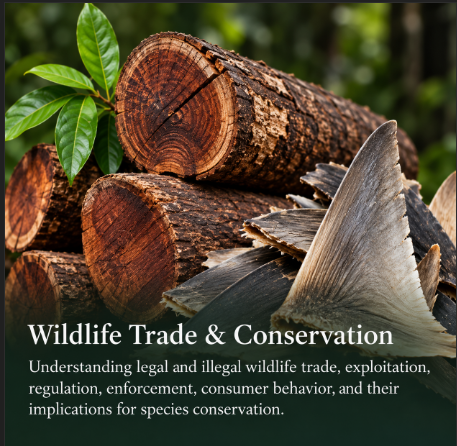
Wildlife Trade & Conservation
Fourteen Years of Live Bat Trade in Indonesia
A 14-year survey of 29 animal markets in southwestern Indonesia examining patterns in the live bat trade and the importance of long-term monitoring for conservation interventions.
Nijman V., Sintya E., Sukmadewi DKT, Putri STG, Chavez J., et al. (2026). Long-term market surveys for live bats in trade in southwestern Indonesia. Science of the Total Environment, 181995.

Species Conservation
Identifying Conservation Priorities for the European Eel
Using the Delphi technique to gather expert knowledge, this study identifies key challenges and priority measures for the recovery of the European eel across international boundaries.
Mukherjee N., et al. (2026). Assessing the conservation challenges for the European eel through the Delphi technique. Global Ecology and Conservation, 04257.

People, Agriculture & Biodiversity
Indigenous Knowledge in Agroforestry Conservation
Research highlights the importance of integrating indigenous management practices with ecological research to reduce pests and pathogens in sustainable landscape management.
Campera M., Skull J., Morton LH., et al. (2026). Indigenous management practices to reduce pests and pathogens of cash crops. Ecology and Evolution, 16(2), 73094.

Wildlife Trade, Policy & Governance
Illegal Wildlife Trade in a Tourism and Biodiversity Hotspot
Evaluating progress toward UN SDGs, this study explores the gap between conservation policy and conditions on the ground in high-biodiversity tourism areas.
Chavez J., Campera M., Hensley LE., et al. Illegal wildlife trade in a tourism and biodiversity hotspot. Sustainable Development, 33, 9106–9122.